
If you are sat in a cold bath and turn on the hot tap, what happens? The water close to your feet becomes unbearably hot and the water near the top half of your body doesn’t noticeably change temperature. Fundamentally, the same process happens in the oceans. The sea nearest to the equator heats up as it receives the highest amount of energy from the sun; the sea nearest to the poles generally loses heat. In the bath, you slosh the water about as it enters the tub to distribute the heat more evenly. In the oceans, currents perform the same job, helping to move heat from the equator to the poles and make higher latitudes more habitable. If, for some reason, the currents transporting heat to higher latitudes slowed, the effect would be similar to you not mixing your bath water. Your feet (the equator and tropics) would become hotter, and your body (the subtropics and poles) would become colder. This is exactly what scientists think they observed in 2009/2010 in the North Atlantic, and they think this may explain some of the freak weather that was observed during that period.
Continue reading Scientists observe what might happen if ocean circulation slows
 In survival situations people often talk about the rule of three. It is said that humans can only survive for 3 minutes without air, 3 hours without heat, 3 days without water and 3 weeks without food. Not wanting to be left out, it seems that some phytoplankton also obey a rule of 3 according to a
 There is a strong chance that the proposed merging of the British Antarctic Survey (BAS) with the National Oceanography Centre (NOC) is
  The 15th Biennial Challenger Conference for Marine Science recently took place at the University of East Anglia in Norwich, on 3-6 September 2012. There were over 100 talks, 150 posters, a contentious debate on wind power, and a talk on how the UK can maintain its current research infrastructure. Over the next week or so Words in mOcean will be bringing you a recap of the best of the action, starting with four of the keynote lectures. Today’s recap is on the lecture given by Ken Buesseler, titled ‘Controls on and variability in particle export and flux attenuation in the ocean’s twilight zone’. Enjoy!
 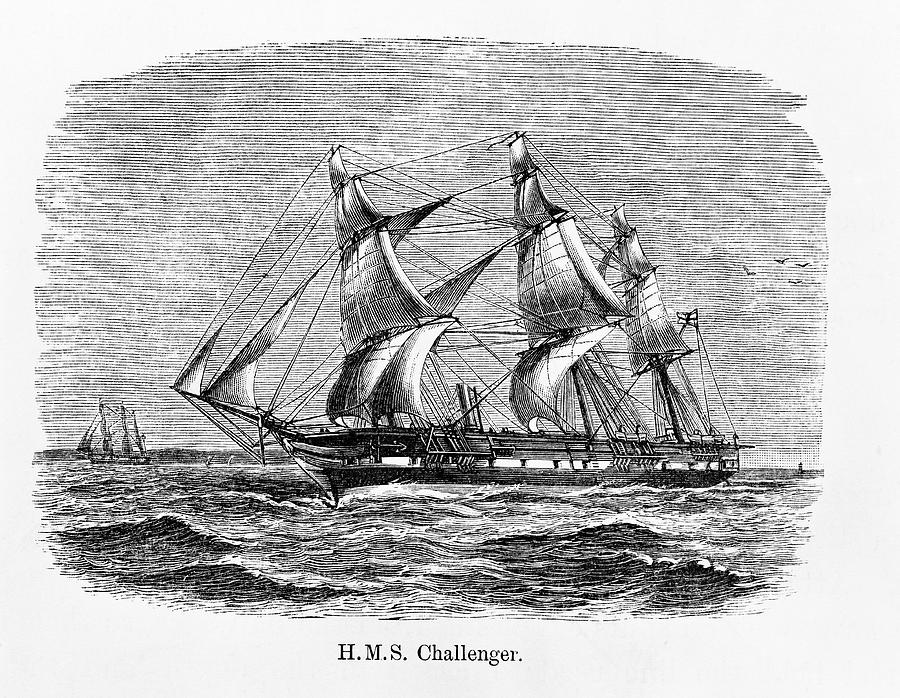 The UK was arguably the pioneer in the field of oceanography: James Cook included information on the oceans in his report on his famous voyages between 1768 and 1779; around about 1800 James Rennell wrote the first textbooks about currents in the Atlantic and Indian Oceans; Sir James Clark Ross took the first sounding in the deep sea in 1840; and the Royal Society sponsored the Challenger expedition (1872–76), the first true oceanographic cruise (laying the foundation for the field), traveling 70,000 nautical miles, resulting in a 50 volume report covering biological, physical and geological aspects of the ocean.
  Words in mOcean