 So, we are one month into our #NewMarineTweep campaign, which aims to get more marine scientists into the Twittersphere. Below is a list of people that have been recruited over the last month – 12 in total, well done marine Tweople! We can’t stop now though; not until Twitter is sick to death of marine science chat should we be satisfied: Continue reading #NewMarineTweep – March
Category Archives: Home
Electron Microscopy: plankton biologist discovers new toy

Out of all the interesting methodologies I have encountered in the first 18 months of my PhD, electron microscopy is indisputably the coolest, most gratifying, and enjoyable. I’m one of those people that loves whatever I’m doing in the moment, as I’m sure my office-mates could attest to. I often come back from trying something new full of enthusiasm and motivation, but that adoration usually dies down after a few days crunching numbers; I end up sitting at my desk pouting over new literature and troubleshooting the protocol. This hasn’t happened with electron microscopy. It has remained steadfast at the front of the pack in the race for my geeky little heart (yes, I actually rank my protocols…don’t we all?), and I don’t see it going anywhere anytime soon. Continue reading Electron Microscopy: plankton biologist discovers new toy
Ocean Jokes

Phytoplankton to the rescue: the promise offered by algal biofuels

President Obama’s administration announced recently that as much as $14 million would be set aside to support the development of biofuels from algae. He was promptly mocked by some sections of the the US media and many of the Republican candidates. Serial ditcher of terminally ill wives, Newt Gingrich, proposed making T-shirts with the slogans, “You have Newt: Drill here, Drill Now, Pay Less. You have Obama: Have Algae, Pay More, Be Weird.” Continue reading Phytoplankton to the rescue: the promise offered by algal biofuels
Our campaign to get more marine scientists onto Twitter

There was a recent post by Carly Strasser (@carlystrasser) with the title ‘Oceanographers: why so shy’. In it, Carly talks about her disappointment at the lack of social media engagement at the recent TOS/ASLO/AGU Ocean Sciences 2012 Meeting and tells the story of how audible clapping broke out when disparaging comments were made about social media in one of the presentations. In many ways this is not completely unexpected. Scientists can be an especially stubborn bunch when it comes to adopting new technology: I’ve heard stories of how, not so long ago, many scientists were reluctant to use PowerPoint Continue reading Our campaign to get more marine scientists onto Twitter
Marine nitrogen fixation: the players
This is the second of two articles written by Elizabeth Sargent on the marine nitrogen cycle; the first article covered some of the basics and can be found here
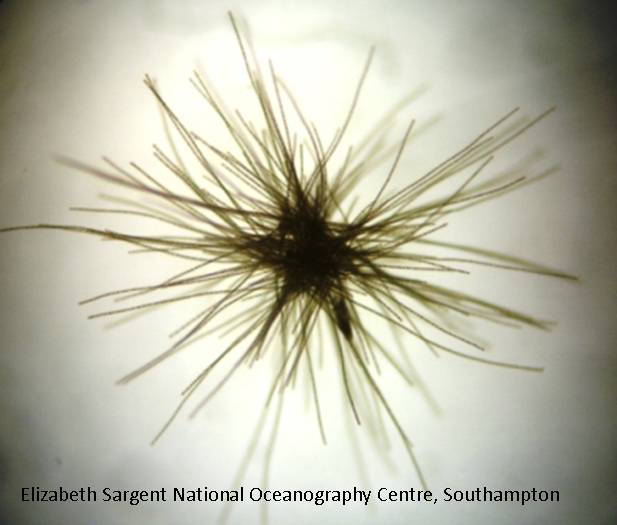
There are three main groups of nitrogen fixing organisms in the ocean: filamentous, heterocystous, and unicellular diazotrophs. The unicells are relatively new to the research scene (discovered in 1998), and are difficult to image due to their size, distribution, and our lack of knowledge about their lifestyle. I have some epifluorescent microscope images of unicellular diazotrophs, but you can get a good idea of what that looks like by picturing the night sky; it’s a whole lot of darkness and some tiny yellow dots. Continue reading Marine nitrogen fixation: the players
The marine nitrogen cycle
This is the first of two articles to be written by Elizabeth Sargent on the marine nitrogen cycle; the second article will go into more depth on nitrogen fixers (or, as Liz refers to them: ‘the diazotrophic organisms I hold near and dear’).

The marine nitrogen cycle is one of the most complicated biogeochemical cycles in the ocean. Nitrogen is a biologically limiting element and changes in its form, or concentration, can cause changes in the cycling of other elements, such as carbon and phosphorus. Marine nitrogen cycling has been and will continue to be an integral component of ocean biogeochemistry, so everyone should know at least the basics. Continue reading The marine nitrogen cycle
Overseas: the wonder and worries of a marine scientist abroad
 With the oceans covering 70% of the planet, it’s inevitable that, as a marine scientist, the opportunity and often necessity for international travel will present itself. Pursuing a career in a highly specialised field may mean leaving your home to work with the brightest and best. Or perhaps your interests are regional: the polar regions, for example, represent some of the most dynamic and urgent areas for oceanographic research in the current climate. A lot of us study science not just for interest in the subject but also Continue reading Overseas: the wonder and worries of a marine scientist abroad
The Elsevier boycott: journals that marine scientists may want to avoid
 So, you may or may not have heard about the plans of many academics (3000 at last count) to boycott journals published by Elsevier. The grounds for doing so were mentioned in this article by the Guardian; the most important passage is copied out below: Continue reading The Elsevier boycott: journals that marine scientists may want to avoid
We are now the ‘award-winning’ Words in mOcean
 It is official: we are now an ‘award-winning’ blog – about bloody time as well; we think we’re great! Thanks to Laura Bretherton (@Phytoplanktonic) for nominating us for the Liebster Blog Award, an accolade that is passed around the internet in order to raise awareness of up-and-coming blogs. I’m sure many of you are aware of Laura and her excellent (double award winning!) blog; if you are not, go check it out… NOW (well, after reading the end of this entry of course), and also follow her on Twitter. Continue reading We are now the ‘award-winning’ Words in mOcean
 Words in mOcean