Monthly Archives: October 2012

A guide to iron fertilisation of the ocean

Follow @D_Aldridge

Image 1: A satellite image of the supposed iron-induced phytoplankton bloom. It seems to attribute all elevated chlorophyll concentrations in the region to the experiment. Chlorophyll is naturally patchy in its distribution, so this image is less than useless (especially as they didn’t even provide satellite images from before the dump!).

It was revealed this week that Russ George, a controversial American Businessman (Deep-Sea News ran a good piece this week covering his chequered history), dumped around 100 tonnes of “iron-rich dirt-like material” off the west coast of Canada in July in order to “gather data targeting all the possible fears that have been raised” about ocean fertilization – an act that is in violation of two international moratoria designed to prevent material from being dumped in the ocean. Judging from the poor quality of news coverage on the issue, which tended to include the deceptive image shown above (Image 1), there are a lot of misconceptions about iron fertilisation of the ocean. Here is the official Words in mOcean idiot’s guide to make you instantly more knowledgeable on this subject. Continue reading A guide to iron fertilisation of the ocean

An Inconvenient Merger: Al Gore has his say on the NOC/BAS merger

There is a strong chance that the proposed merging of the British Antarctic Survey (BAS) with the National Oceanography Centre (NOC) is going to harm the UK’s ability to conduct climate change research. There is also a suspicion amongst many that the NOCS/BAS merger ‘consultation’ is just for show, and that the decision has already been made to merge the two institutions. It is perhaps fitting then that veteran of phony ‘democratic’ processes, former democrat presidential candidate (and Vice-President) Al Gore, has decided to weigh in with his opinion on the matter: Continue reading An Inconvenient Merger: Al Gore has his say on the NOC/BAS merger
Half of everything you [n]ever wanted to know about diatoms

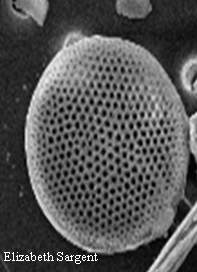
Image 1: SEM (scanning electron microscopy) image of a diatom showing its ‘elaborate glass wall’.

Diatoms, a group of phytoplankton, are amazing on a variety of levels. For one thing, their cell walls are made of silica meaning each one lives in a little glass house, and an elaborate one at that (Image 1). Those ornate ‘holes’ do have a function. One of the biggest hurdles phytoplankton face is avoiding sinking. Since silica is dense compared to seawater, this honeycomb-esque pattern reduces the weight of diatom, thus still allowing it to benefit from the protection provided by a ‘glass’ wall without causing it to sink rapidly. They also use other mechanisms to reduce sinking such as carbohydrate ballasting or air bubble entrapment among setae (spines). Continue reading Half of everything you [n]ever wanted to know about diatoms

Collecting snow in the tropics

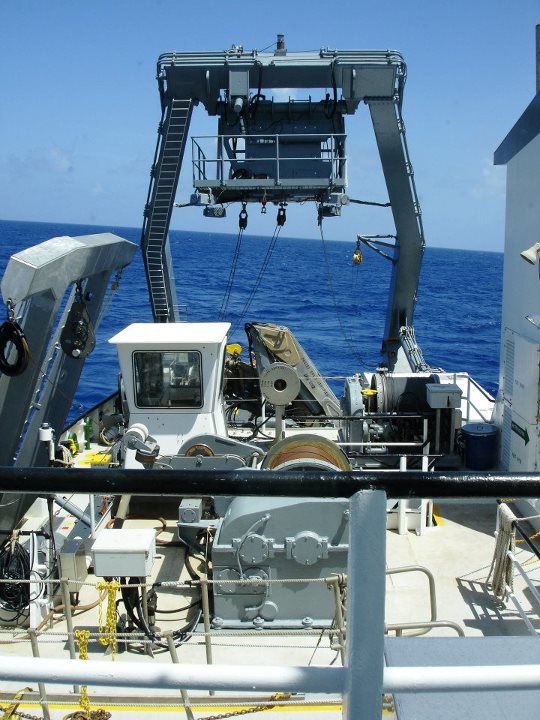
R/V Atlantic Explorer at sea

After 2 months of packing, planning, prepping, and fretting, I finally boarded a plane to Bermuda in mid August to take part in a research cruise aboard the R/V Atlantic Explorer. This was set to be the third and final research expedition of my PhD, and I had firm plans to tie up some loose ends from previous sampling and to [hopefully] confirm a few hypotheses I’ve been juggling about for the past year. Like any research expedition, we faced a few hurdles with engine troubles and impending tropical storms, but managed to leave port only 2 days late, and were able tack on an extra day of sampling on the end to make up for lost time. All in all there was no harm done, except maybe to my ever-dwindling research training and support grant, which certainly took a few hard knocks with flight changes. Continue reading Collecting snow in the tropics